Greenhouse Tractors
Greenhouse farming requires agricultural equipment that can operate efficiently in confined spaces while providing sufficient power and maneuverability. Compared with open-field farming, greenhouse environments often have narrower working areas, limited turning space and specific requirements for tractor dimensions.
Compact and narrow tractors can be used for various greenhouse operations, including soil preparation, rotary tilling, cultivation, mowing, fertilizing and material transportation.
The appropriate tractor depends on greenhouse layout, aisle width, soil conditions, crop type, required implements and available working space.
Tractor Applications in Greenhouse Farming
Compact tractors can support a wide range of greenhouse operations, including:
- Soil preparation
- Rotary tilling
- Inter-row cultivation
- Weed control
- Mowing
- Fertilizing
- Material transportation
- Trailer towing
- Greenhouse maintenance
Using a tractor that matches the available working space and implements can improve operating efficiency and reduce manual labor.
Choosing a Tractor for Greenhouse Farming
1. Tractor Width and Greenhouse Aisle Spacing
Working space is one of the most important factors when selecting a greenhouse tractor.
The tractor should be narrow enough to move through greenhouse aisles while maintaining sufficient clearance from crops, greenhouse structures and other equipment.
Before selecting a tractor, consider:
- Greenhouse aisle width
- Entrance and door dimensions
- Turning space
- Crop spacing
- Tractor overall width
- Implement working width
For narrow greenhouse environments, compact tractors can provide better maneuverability than larger agricultural tractors.
2. Tractor Height
Tractor height can also be important in greenhouse applications.
Some greenhouses have limited vertical clearance, particularly around entrances, structural supports and crop areas.
Customers should check:
- Tractor overall height
- Greenhouse entrance height
- Structural clearance
- Crop canopy height
- Clearance around greenhouse equipment
A compact tractor with suitable dimensions can reduce interference when operating inside confined greenhouse areas.
3. 2WD or 4WD
The choice between 2WD and 4WD depends on greenhouse soil and working conditions.
2WD tractors can be suitable for relatively flat and firm greenhouse surfaces and lighter agricultural operations.
4WD tractors provide additional traction and can be useful when working on soft soil, uneven ground or when using heavier implements.
4. Wheeled or Crawler Tractor
Both wheeled and crawler tractors can be considered for greenhouse applications, depending on the working environment.
Wheeled tractors provide good mobility and are suitable for general cultivation, transportation and maintenance operations.
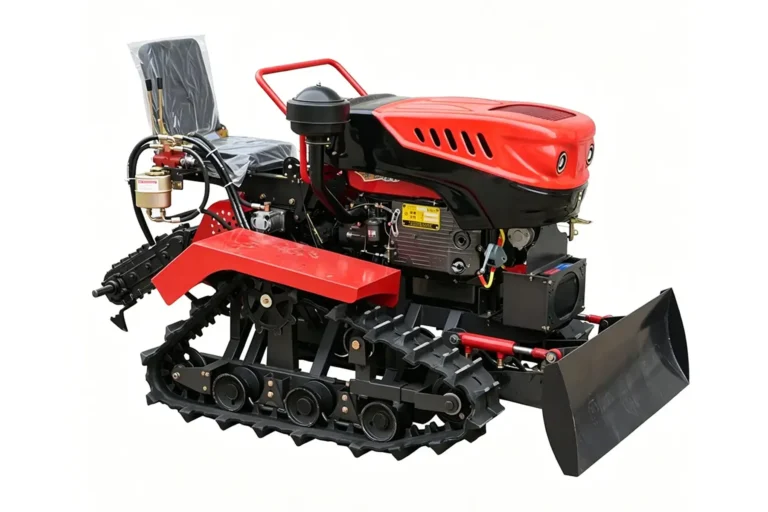
Crawler tractors provide greater ground contact and can be useful for soft, muddy or uneven ground conditions.
The choice should be based on soil conditions, greenhouse layout and the required operations.
5. Horsepower and Implement Requirements
Horsepower should be matched to the actual workload and implements.
Lower-horsepower compact tractors may be suitable for:
- Mowing
- Spraying
- Weeding
- Light cultivation
- Material transportation
Higher-horsepower tractors may be required for heavier tillage, larger implements or demanding transportation work.
Common greenhouse implements include:
- Rotary tillers
- Cultivators
- Mowers
- Weeders
- Fertilizer spreaders
- Sprayers
- Trailers
PTO capability, hydraulic capacity, tractor weight and implement working width should also be considered when selecting a tractor.
Suitable Equipment for Greenhouse Farming
Compact Wheeled Tractors
Compact wheeled tractors are suitable for general greenhouse cultivation, mowing, fertilizing and material transportation.
Their compact dimensions make them easier to maneuver in confined agricultural environments.
Narrow Agricultural Tractors
Narrow tractors can be used where greenhouse aisles or crop rows provide limited operating space.
Their smaller overall width can make them more suitable for narrow working areas than conventional full-size agricultural tractors.
Crawler Tractors
Crawler tractors can be considered for greenhouses with soft soil, uneven ground or conditions where additional traction and ground contact are required.
Key Considerations When Selecting a Greenhouse Tractor
Before purchasing a tractor for greenhouse farming, customers should consider:
1. Greenhouse aisle width
Measure the available operating width and compare it with the tractor’s overall width.
2. Entrance dimensions
Check whether the tractor can safely pass through greenhouse doors and entrances.
3. Vertical clearance
Consider tractor height and the available clearance inside the greenhouse.
4. Turning space
A smaller turning radius can make maneuvering easier in confined areas.
5. Soil conditions
Determine whether the ground is firm, soft, muddy or uneven.
6. Required implements
Identify the equipment that will be used with the tractor.
7. Horsepower and PTO
Match engine power and PTO capability to the required implements.
8. Drive configuration
Choose between 2WD and 4WD according to traction requirements.
Greenhouse Tractors from SD Lander Machinery
SD Lander Machinery provides compact wheeled tractors and crawler tractors for different agricultural applications.
For greenhouse farming, customers can select tractor configurations according to:
- Horsepower
- Tractor width
- Tractor height
- 2WD or 4WD
- Wheeled or crawler configuration
- Soil conditions
- Greenhouse aisle spacing
- Required implements
Our compact tractor range can support greenhouse farming, vegetable production, small-scale agricultural operations and other applications where maneuverability and compact dimensions are important.
View our tractor products to find a suitable configuration for your greenhouse application.